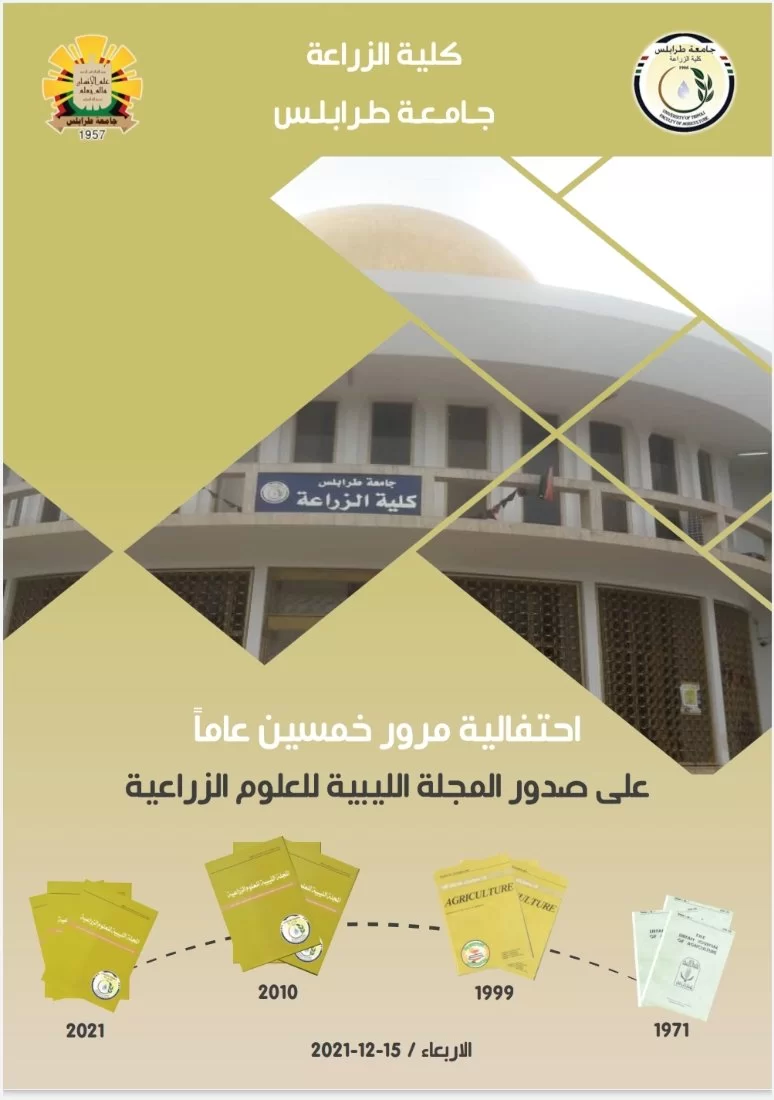
كلية الزراعة طرابلس

المزيد ...

حول كلية الزراعة طرابلس

حقائق حول كلية الزراعة طرابلس

نفتخر بما نقدمه للمجتمع والعالم

253

المنشورات العلمية

184

هيئة التدريس

522

الطلبة

0

الخريجون

من يعمل بـكلية الزراعة طرابلس

يوجد بـكلية الزراعة طرابلس أكثر من 184 عضو هيئة تدريس

staff photo

د. عبير مسعود محمد القبلاوي

عبير القبلاوي هي احد اعضاء هيئة التدريس بقسم وقاية النبات بكلية الزراعة طرابلس. تعمل السيدة عبير القبلاوي بجامعة طرابلس كـمحاضر منذ 2012-06-26 ولها العديد من المنشورات العلمية في مجال تخصصها

منشورات مختارة

بعض المنشورات التي تم نشرها في كلية الزراعة طرابلس

مسح مبدئي لآفات الصوف في بعض المناطق بليبيا ودراسة لحياتية خنفساء الأثاث الكبري Anthrenus flavipes (Le Conte) Coleoptera: Dermestidae))

تم إجراء مسح مبدئ لأهم الآفات الحشرية التي تصيب السجاد والمنسوجات بمواقع مختلفة من ليبيا ودراسة تأثير درجات الحرارة والضوء والتغذية على دورة حياة خنفساء الأثاث الكبرى Anthrenus flavipes وتتبع دورة الحياة بالمعمل من شهر 5 – 2008 حتى شهر 6 – 2009.دلت نتائج المسح الأولي على وجود العديد من الآفات الحشرية على الصوف في الأماكن التي تمت زيارتها وأشتملت على ثلاثة أنواع من فصيلة Dermestidae وهي Anthrenus flavipes، piceus Attagenus، وpimpinella Anthrenus ونوعين من فصيلة Tinidae هما pellionella Tinea، وbiselliella Tineola. وقد لوحظ تواجد خنفساء الأثاث الكبرى A. flavipes في عدة مواقع مختلفة وبأعداد كبيرة مقارنة ببقية الأنواع.دلت النتائج على أن أقصر دورة حياة لخنفساء الأثاث الكبرى A. flavipes كانت قد تحققت عند درجة حرارة 32 ̊م ثم عند 28 ̊م و25 ̊م وكانت الفروق معنوية بين المتوسطات، أما ما يتعلق بتأثير ساعات الضوء والظلام فقد تبين أن أقصر دورة حياة لهذه الحشرة كانت قد تحققت عند التربية تحت 24 ساعة ظلام، ثم 18 ساعة ظلام و6 ساعات ضوء، وأن أطول دورة حياة في هذه التجربة كانت عند 6 ساعات ظلام و18 ساعة ضوء، وكانت الفروق معنوية.كما تبين من خلال نتائج دراسة تأثير الغذاء والتجويع على دورة حياة A. flavipes أن أقصر دورة حياة كانت قد تحققت عند تغذية اليرقات على صوف + خميرة + كوليستيرول كما كان لهذه المعاملة تأثيرات هامة على حياتية البالغات وخاصة على معدلات وضع البيض وكانت الفروق معنوية.وقد أشارت نتائج الدراسة المعملية على أن أكثر تواجد للبالغات كان قد سجل خلال فترات الحرارة المرتفعة من السنة والتي سجلت بها أعلى معدلات للتكاثر ووضع البيض وذلك خلال الأشهر مايو ويونيو وأغسطس. Abstract Preliminary survey was conducted to detect the most harmful insect pests of carpet, wool, fabrics, leather, and museum specimens at certain locations in Libya.Three species of family Dermestidae - Anthrenus flavipes, A. pimpinella and Attagenus piceus, in addition to Tineola biselliella and Tinea pellionella from family Tinidae were very common. The carpet beetle Anthrenus flavipes was one of the most abundant and destructive.Temperature, light, and nutrition were also tested for their effect on the length of life cycle of furniture carpet beetle Anthrenus flavipes, which was also monitored in laboratory from May 2008 to June 2009.Studies on the effect of temperature on the duration of life cycle of A. flavipes indicated that shortest life cycle duration was achieved when the insect was reared at 32 c°, followed by 28, and 25 c°.Experiments on the effect of light and dark hours of the day on life cycle of A. flavipes indicated that shortest life cycle was achieved when the insect was reared under 24 hours of darkness, then at 18 hours, and 6 hours of darkness during the day. Differences in both experiments were significant. Nutrition and starvation significantly affected life cycle duration of A. flavipes. Shortest duration was recorded when insects were fed on (wool + yeast + cholesterol); this treatment also increased the ammount of eggs laid by A. flavipes adults.Laboratory studies demonstrated that adults were most abundant during May, June, and August.
فايدة عيسى سعيد الككلى (2011)
Publisher's website

Study of C/N ratio of organic materials and its application in the production of natural fertilizer (bokashi)

Bokashi is an organic fertilizer made from organic materials through fermentation process. A high quality bokashi should have C/N ratio between 10-20, which normally produced from a mix raw organic material with has C/N ratio of 30. However, many studies have shown a composition of raw organic material without a calculation of C/N ratio. Therefore, the objectives of this study were to gather the initial C/N ratio of various raw material from previous published studies, calculate the C/N ratio, and examine the descriptive characteristic (colour, aroma, and texture) of bokashi made from three selected C/N ratios of raw material (30, 70, and 110) and various length of fermentation (10, 17, and 24 days). This research combined literature reviews and laboratory experimental. For laboratory experimental, Complete Randomise Design (CRD) was applied. The result showed that all bokashi produced from raw material mixture with the C/N ratio up to 110 was still acceptable to be directly applied as a fertilizer. Bokashi produced with longer fermentation time had better texture but lower aroma and colour quality
RABYA A LAHMER(1-2021)
Publisher's website

(تحديد إنتشار وتداخل ترب السبخات بالمنطقة الشمالية الغربية للجماهيرية العظمي وذلك باستخدام تقنيات الاستشعار عن بعد ونظم المعلومات الجغرافية)

تعتبر هذه الدراسة من أولى الدراسات في هذه المنطقة حيث تم استخدام تكنولوجيا نظم المعلومات الجغرافية والاستشعار عن بعد باستخدام منظومة (ERDAS IMAGINE 8.4) ومنظومة (ArcGIS 9.2) و(ArcView 3.3) والتحاليل المختبرية والمعلومات المتاحة الأخرى وذلك لمقارنة حالة السبخات وانتشارها لفترات زمنية معينة لمنطقة الدراسة (لفترة 29 سنة ماضية) وتم الاستعانة بالمرئيات الفضائية بتاريخ ( 1972-1987-2001) للقمر الاصطناعي (Landsat) وتبين أن مساحة هذه السبخات في تناقص طيلة الفترة الزمنية السابقة بسبب تعرض هذه المنطقة للتعرية الريحية بصورة شديدة وزحف الرمال على هذه السبخات بسبب الظروف المناخية القاسية بالمنطقة حيث أن طبيعة السبخات بالأقمار الصناعية لم تعد واضحة بسبب الغطاءات الرملية وكانت نسبة التغير في وحدة المساحة حوالي 0.45 % لكل سنة . وأن إجمالي التغير في المساحة الكلية للفترة الممتدة من سنة (1972 إلى سنة 2001) أي خلال فترة 29 سنة أظهر تناقصاً في هذه المساحة للسبخات بحوالي من 43639.04 هكتار إلى مساحة 38043.54 هكتار أي مساحة ما يعادل 5595.50 هكتار وبنسبة تغير 12.82 %. واختيرت سبخة قريبة مطلة على البحر (سبخة بوكماش) وسبخة أخرى تبعد عن الساحل بمسافة 10 كيلومتر تقريبا (سبخة زلطن) وتم إنتاج خريطة مطابقة لكل سبخة، وحساب المساحة لهذه السبخات المختارة ومعرفة نسبة التغير فيها خلال هذه الفترة فوجد تناقص ملحوظ في المساحة بالنسبة لهذه السبخات المختارة فكان إجمالي التغير خلال الفترة الممتدة من سنة (1972 إلى سنة 2001) فترة 29 سنة قلت فيها مساحة سبخة زلطن من .67253 هكتار إلى 208.56 هكتار أي حوالي 45.11 هكتار وبنسبة تغير 17.78 %. أما بالنسبة لسبخة بوكماش فكان إجمالي تغير المساحة من سنة (1972 إلى سنة 2001) فترة 29 سنة تقريبا قلت المساحة من حوالي 223.19 هكتار إلى 182.01 هكتار أي فقدت مساحة 41.18 هكتار تقريبا وبنسبة تغير 18.45 % من المساحة الكلية للسبخة ويعزى السبب في الاختلاف في النتائج عن سبخة زلطن لكون سبخة بوكماش تقع على ساحل البحر مباشرة وتتأثر بالظروف المناخية بصورة أكبر. وخلال استعراض البيانات السابقة لمنطقة الدراسة يمكن القول إن حالة السبخات في المنطقة تتناقص وذلك لتغطيتها بالرمال المتحركة ولم تعد ظاهرة علي السطح طيلة الفترة الزمنية السابقة. و تم اختيار عدد من قطاعات التربة الممثلة للسبخات المختارة سابقا أي قطاع ممثل لامتداد مساحة السبخة لكل سنة من السنوات المدروسة وتم أخذ عينات التربة من هذه القطاعات لإجراء التحاليل اللازمة لمقارنة حالة التربة في هذه القطاعات الممثلة لكل سنة من السنوات ووجد أن القطاعات الممثلة للسبخات سنة (1972) تزرع الآن بمحاصيل الحبوب (الشعير) و بعض الأشجار الحولية مثل الكروم واللوزيات والزيتون وقطاعات السبخة الممثلة لسبخة سنة (1987) تزرع بمحاذاة السبخات بمحاصيل الحبوب (الشعير) وهما عبارة عن سبخات مغطاة بترب عادية، أما القطاعات الممثلة للسبخات سنة (2001) فهي عبارة عن ترب سبخات ذات ملوحة عالية لا تصلح للزراعة وتحتوي بعض الشجيرات الملحية والمتمثلة في الغدام والغسول والروثا . ومن خلال هذه النتائج المتحصل عليها يجب المحافظة على هذه المساحات الجديدة واستصلاح ما يمكن استصلاحه منها بصورة مناسبة ومنع إعادة تراكم الأملاح بها ، وصد الرياح والحد من سرعتها للتقليل من خطر التعرية الريحية، والحفاظ على البيئة البرية في هذه المناطق ومحاولة إكثار الحياة البرية بها ، والتعرف على نقاط الضعف بالكثبان الرملية الشاطئية التي تودي إلى تسرب مياه البحر أثناء فصل الشتاء نتيجة المد والجزر، والتي تساهم مساهمة كبيرة في انتشار وتوسع السبخات بالمناطق المنخفضة القريبة من الساحل وعليه محاولة ردم تلك النقاط بتربة من نواتج مخلفات المحاجر أو كتل صخرية كبيرة للحد من تأثير مياه البحر على تلك المناطق . Abstract This is one of the first studies detecting the change in saline land (Sabkha) overtime in northwest Libya. The modern technologies were used, including geographic information systems (ArcGIS 9.2 and ArcView 3.3) and remote sensing system (ERDAS IMAGINE 8.4).Laboratory analysis and other available information were carried out to compare the state of the Sebkha and its deployment over specific time periods (for a period of 29 years ago). The Landsat images were selected to the following years (1972-1987-2001) Two saline flat (Sabkha) were chosen, first one was selected close to the sea (Sebkhat Bokmash) and second was far from the coast by about distance of 10 kilometers (Sebkhat Zaltan).The results showing that, saline flats were decrease throughout the period of time, which may be explained due to the exposure for wind erosion and sand encroachment over these flats. The percentage of change per unit area is about 0.45% per year. The total change in the whole study area for the period between1972 to 2001 was decreased from 43,639.04 hectares to an area of 38,043.54 hectares. The losing area of 5595.50 hectares, equivalent to a change rate 12.82%. Results were used to produce a map corresponding to each Sebkha, and calculate the proportion of change during this period. Area of Sebkhat Zaltan was decreased from 253.67 hectares to 208.56 hectares or about 45.11 hectares and a changeable rate of 17.78%. The same trend was detected for Sebkhat Bokmash, the area was decreased from 223.19 hectares to 182.01 hectares, an area of 41.18 hectares lost almost changed by 18.45% of the total area. The difference in the results from Sebkhat Zaltan and Bokmash were explained by the fact that the Sebkhat is located on the coast of the sea directly affected by climatic conditions. In addition, most of the studied flats were covered by sand sheets due to the activity of wind erosion.Numbers of sectors representing the salt flats were selected to represent the Sebkhat area for each of the years, soil samples were taken from these sectors for analysis to compare the condition of the soil in these sectors represented each of the years. Results showing that, sectors represented in the flats (1972) are cultivated by cereal crops (barley) and some trees such as almonds, grapes, olives. Sectors representing the Sebkhat year (1987) were planted with cereal crops (barley). The representative sectors of flats a year (2001), soils were highly saline and are not suitable for agriculture. These areas are dominated by some salt shrubs as Algdam, Alghsool, Alrothe. Through the results obtained must be maintained these new areas, rehabilitation of what can be reclaimed and prevent re-accumulation of salts, repel the wind and reducing speed to reduce the risk of wind erosion. In addition to, identification the weaknesses of coastal sand dunes which lead to seawater intrusion during the winter as a result the tides, which contribute significantly to the spread and expansion of low-lying salt flats near the coast. Practically, coastal flats need attempt to bridge those points from the output of waste soil quarries or large boulders to reduce the impact of sea water.
حمدي عبد الخالق علي الزرقاني (2010)
Publisher's website