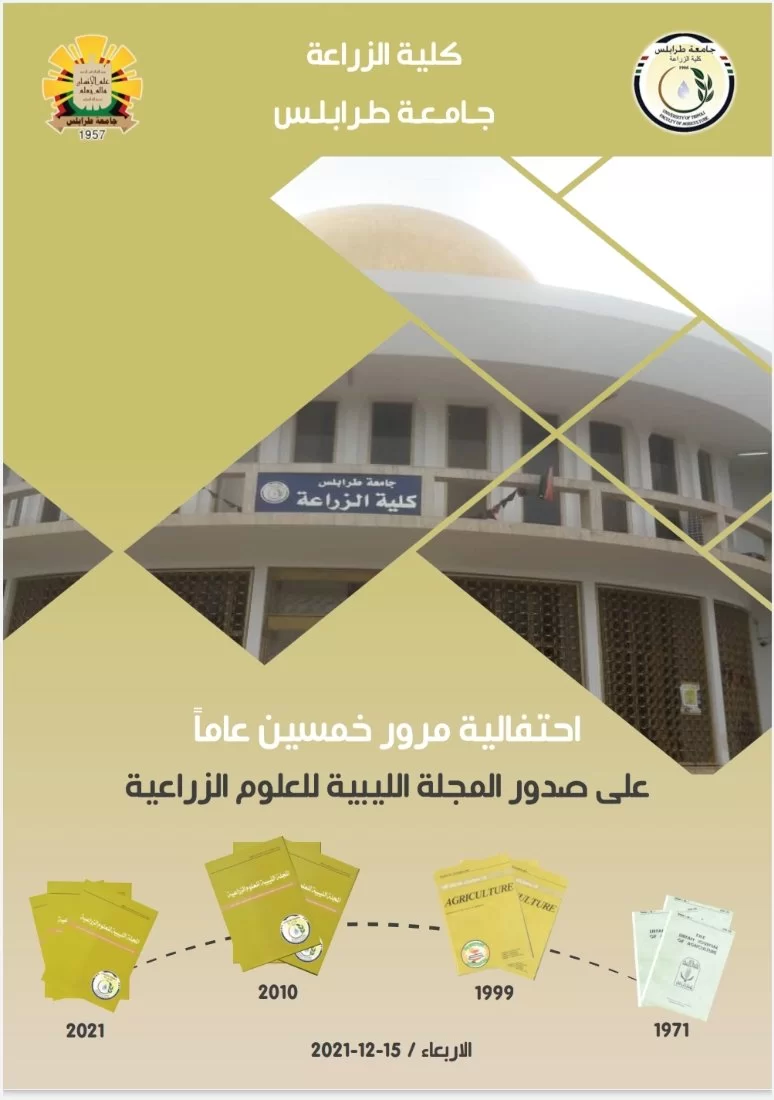
كلية الزراعة طرابلس

المزيد ...

حول كلية الزراعة طرابلس

حقائق حول كلية الزراعة طرابلس

نفتخر بما نقدمه للمجتمع والعالم

253

المنشورات العلمية

184

هيئة التدريس

522

الطلبة

0

الخريجون

من يعمل بـكلية الزراعة طرابلس

يوجد بـكلية الزراعة طرابلس أكثر من 184 عضو هيئة تدريس

staff photo

أ. مبروكة علي المبروك عبدالهادي

منشورات مختارة

بعض المنشورات التي تم نشرها في كلية الزراعة طرابلس

Predicting the classes and distribution of salt-affected soils in Northwest Libya

Sodicity and salinity can adversely affect soil structure and are common constraints to plant growth in arid regions. Current remote sensing techniques cannot distinguish between the various classes of salt-affected soils. Field and laboratory measurements of salt-affected soils are time-consuming and expensive. Mapping of the salt-affected soils can be used in soil conservation planning to identify regions with different degrees of limitations. There is a need to use existing field and laboratory measurements to create maps of classes of salt-affected soils. The objectives of this study are to classify salt-affected soils, use existing field data to interpolate and validate geospatial predictions of the classes of salt-affected soils using Geographic Information Systems (GIS), and create maps showing the different classes and distribution of salt-affected soils. The classification framework for salt-affected soils is based on electrical conductivity (ECe), soil pH and the sodium adsorption ratio (SAR), and provides four degrees of limitations to salt-affected soils: slight (normal soils), moderate (saline soils), severe (sodic soils), and extreme (saline-sodic soils). Spatial interpolation of the field data from northwestern Libya was verified by cross-validation, and maps of the salt-affected soils in the region were created. The majority of soils in this region of Libya are normal (slight degree of limitation). Twenty percent of the topsoil is saline-sodic (extreme degree of limitation). Land use recommendations and rehabilitation strategies can be developed from such maps of salt-affected soil classes. The methodology followed in this study can be applied to other arid regions around the world, particularly in developing countries where budgetary constraints limit detailed field and laboratory measurements of sodicity and salinity. arabic 11 English 70
Hamdi Zurqani, Elena Mikhailova, Christopher Post, Mark Schlautman, Julia Sharp(2-2018)
Publisher's website

تأثير إضافات مختلفة من التين الشوكي وقواعد أوراق النخيل و الكومبوست على بعض الخواص المائية للتربة الرملية

This laboratory study aims to investigate the effect of adding dry grinders of Cactus (Opuntia ficus- indica) and palm leaf bases (Rachis) and commercial soil enhancer (Compost) with different mixing ratios (2.5, 5.0, 7.5%, by weight) on improving hydraulic properties of sandy soil. Hydraulic properties included the water retention capacity, the saturated hydraulic conductivity, and the moisture content at tension values of 0.3, 1, 10 and 15 bar. These properties were estimated at the beginning of the experiment, and after six months, during which moisture and drying cycles had taken place. Through the obtained results, it was found that all additives improved the soil hydraulic properties, so that the values of the soil retention capacity and soil moisture content versus tension increased. On the other hand, all additives reduced the values of the hydraulic conductivity. The results also indicated lack significant effect of time (at the level of 5%). The different mixing ratios did not significantly affect the hydraulic conductivity (at the level of 5%). However, the results showed that the rachis grinders and the mixture consisting of rachis and cactus outperformed in hydraulic properties as compared with other t
د.احمد ابراهيم خماج, د. احمد ابوالعيد قنفود, المنتصر بالله مختار القريقني, , , , (6-2020)
Publisher's website

Assessment of spatial and temporal variations of soil salinity using remote sensing and geographic information system in Libya

Soil salinity is one of the most important issues in arid and semi arid regions, which is directly linked to desertification and land degradation. Several studies related to soil and water salinity assessment, and mapping were conducted in Libya using traditional methods. However, they covered only the time of measurements and did not address the dynamic nature of salinity process. In addition, they lack cost and time effectiveness. Therefore, there is pressing need to use a high tech method that is cost, time and labor effective to assess the change in soil salinity in north- west of Libya. The aim of this paper is to identify the change in saline soils (Sehbkha) using Remote Sensing (RS) and geographic information system (GIS) techniques. Land Sat Satellite images data were acquired for 29 years (1972-1987-2001) to assess the pattern of change. The result revealed that there was a decrease saline soils area ( Sbehbka). Keywords: Libya, GIS, Remote Sensing, Soil, Soil Salinity, Sebkha. arabic 17 English 109
Hamdi Zurqani, Bashir Nwer, Azzeddin Elhawej(12-2012)
Publisher's website