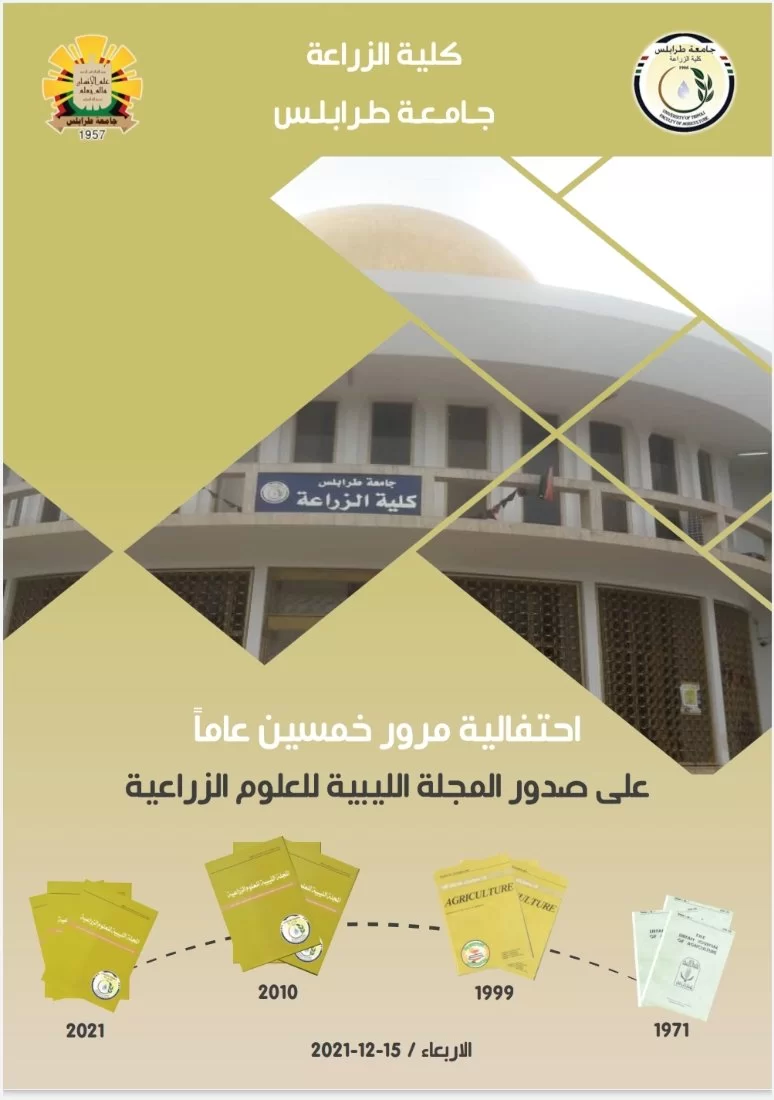
كلية الزراعة طرابلس

المزيد ...

حول كلية الزراعة طرابلس

حقائق حول كلية الزراعة طرابلس

نفتخر بما نقدمه للمجتمع والعالم

253

المنشورات العلمية

184

هيئة التدريس

522

الطلبة

0

الخريجون

من يعمل بـكلية الزراعة طرابلس

يوجد بـكلية الزراعة طرابلس أكثر من 184 عضو هيئة تدريس

staff photo

د. جميلة الطاهر أحمد رزق الله

الدكتورة جميلة رزق الله من مواليد طرابلس، ليبيا. تحصلت على بكالوريوس طب بيطري من كلية الطب البيطري، جامعة طرابلس، طرابلس 1999. بعد حصولها على درجة الماجستير في أمراض الأحياء المائية البيطرية من قسم الزراعات المائية من جامعة ستيرلينغ 2005. عملت من 2006-2010 كمساعد محاضر في قسم الزراعات المائية، كلية الزراعة، جامعة طرابلس، طرابلس حيت عينت رئيس لقسم الزراعات المائية 2010. تحصلت على درجة الدكتوراة في أمراض الفروج الأحمر الحر من قسم الزراعات المائية، جامعة ستيرلينغ، أسكوتلندا 2017. عادت لقسم الزراعات المائية 2017 لتعمل كمحاضر لتدريس امراض الأسماك في جامعة طرابلس ودوليا. أسست مشروع كرة الثلج لدراسة التنوع الحيوي بالساحل الليبي 2018-للوقت الحالي). يتمحور المشروع على دراسة أمراض الأسماك ودراسة التنوع الحيوي والأحياء البحرية الغازية والأحياء البحرية الضخمة كالسلاحف البحرية بالدراسة الميدانية واستخدام صفحات التواصل الاجتماعية والاستعانة بالمواطن الباحث. لها العديد من المؤلفات المنشورة

منشورات مختارة

بعض المنشورات التي تم نشرها في كلية الزراعة طرابلس

تصنيف الأخطبوط في الساحل الغربي الليبي لمدينتي صرمان وصبراتة.

هدفت الدراسة الحالية إلى معرفة الأنواع المنتشرة في الساحل الغربي الليبي ، وتحديد النسبة بين الجنسين ( ذكور و إناث )، وأظهرت نتائج الدراسة وجود ثلاثة أنواع من الأخطبوطات في الساحل الغربي لمدنيتي صرمان،وصبراتة وهي: Octopus vulgaris (Cuvier,1797)و Eledonemoschata (Lamarck,798)وPteroctopustetracirr-hus (DelleChiaje,1830) و كان مدى الأطوال الكلي لها 18-78سم، 29- 46سم ،32- 71سم على التوالي،وكان النوع O.vulgaris أكثر انتشاراً،وكانت نسبة الإناث أعلى من الذكور .
هالة محمد الاسود(9-2020)
Publisher's website

Ulcerative dermatitis in wild dusky grouper Epinephelus marginatus (Lowe) from Libyan waters

In the period 2013–2015, wild dusky grouper, Epinephelus marginatus (Lowe), caught in Libyan coastal waters and ranging in size from 42 to 92 cm in total length, were observed to have distinctive skin lesions of unknown aetiology. Histopathologically, the lesions comprised a multifocal, unilateral or bilateral dermatitis, involving the epidermis, superficial dermis and scale pockets, and sometimes, in severe cases, the hypodermis. Severe lesions had marked epidermal spongiosis progressing to ulceration. Healing was observed in some fish. Bacteria and fungi could be isolated from severe lesions, although they were not seen histopathologically in early‐stage lesions. By contrast, metazoan parasite eggs were observed in the dermis and epidermis of some fish with mild and moderate dermatitis. Unidentified gravid digenean trematode parasites carrying similar eggs were also seen within the blood vessels of the deep and superficial dermis. The cause of this distinctive condition, termed dusky grouper dermatitis (DGD), and its potential impact upon already threatened Mediterranean wild dusky grouper populations and upon cultured grouper more widely have yet to be established.
Jamila taher ahmed rizgalla(5-2016)
Publisher's website

Estimation of Some Genetic Parameters of The Growth and Wool Characteristics of The Libyan Barbary Sheep

A B S T R A C T Records on 306 Libyan Barbary lambs descended from 232 ewes sired by 25 rams were included during the period from 2004 - 2009. Analyses were used by ASREML to estimate (CO)Variance, Additive and maternal heritability and Correlations; fitting an animal model including maternal genetic for live weight traits. The objective was to evaluate the performance and previously mentioned genetic parameters in some traits of Barbary sheep in Libya. Mean birth weight (BW), weaning weight (WW) and adjusted weaning weights (adjWW) were 3.11±0.06, 21.11±0.08 and 21.62±0.02 kg respectively. Mean greasy fleece weight (GFW), staple length (SL) and number of crimps/2cm. was 1.98±0.67 kg., 9.67±1.64 cm. and 11.02±1.56 respectively. The additive heritability estimates for (BW), (WW) and (adj WW) were 0.11, 0.21 and 0.27 respectively. The maternal heritability estimates for (BW), (WW) and (adj WW) were 0.05, 0.11 and 0.25 respectively. These results indicate that selecting for improved maternal and for direct effects in Barbary sheep would generate slow genetic progress in BW trait. Direct and maternal genetic and phenotypic correlations among the lamb weights varied between 0.08 and 0.966. The Repeatability estimates for (GFW), (SL) and crimps/2cm were 0.13, 0.03 and 0.03 respectively. The positive phenotypic correlation coefficient between the wool traits of the Libyan Barbary sheep ranged from 0.61 to 0.456. The negative correlation ranged from – 0.259 to – 0.036; It was the highest positive and significant correlation between number of fine and coarse crimps/2cm was 0.456, while the highest negative and significant correlation between number of crimps of fine fiber and coarse fiber ratio was 0.259. It concluded that Low estimates of additive and maternal heritability for live weights indicated the presence of less additive genetic variance and large environmental variance. Hence, improvement through selection may be limited in growth traits if the causes of environmental variation are not removed. Only year’s records can be trusted to predict performance in the wool traits when temporary environmental impacts are minimized. arabic 15 English 89
Ahtash. Abdulkarim , Abo-Zakhar, Aiad , Fathi Abousaq(1-2021)
Publisher's website