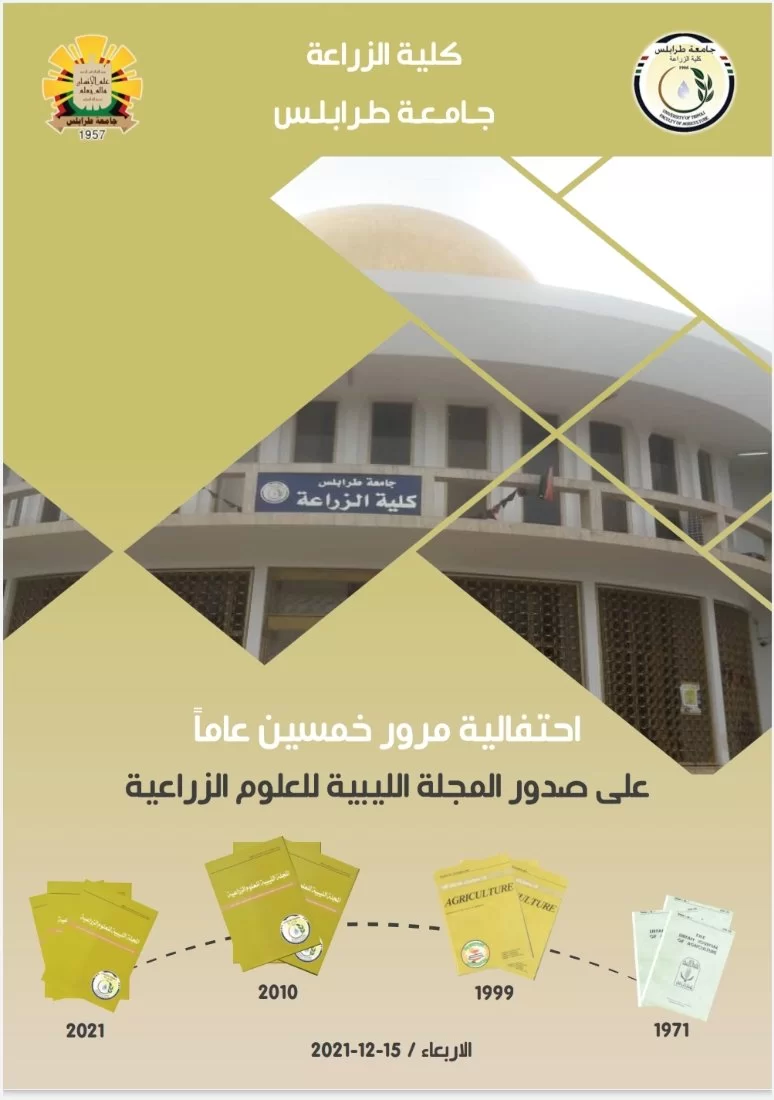
كلية الزراعة طرابلس

المزيد ...

حول كلية الزراعة طرابلس

حقائق حول كلية الزراعة طرابلس

نفتخر بما نقدمه للمجتمع والعالم

253

المنشورات العلمية

184

هيئة التدريس

522

الطلبة

0

الخريجون

من يعمل بـكلية الزراعة طرابلس

يوجد بـكلية الزراعة طرابلس أكثر من 184 عضو هيئة تدريس

staff photo

د. عمار عمران عبدالسلام الشمام

عمار الشمام أحد أعضاء هيئة التدريس بقسم المحاصيل / كلية الزراعة / جامعة طرابلس منذ 29.08.2010، تحصل على الدكتوراة من جامعة نوتنقهام / المملكة المتحدة بتاريخ 26.05.2020 ، وله العديد من المنشورات في مجال تخصصه.

منشورات مختارة

بعض المنشورات التي تم نشرها في كلية الزراعة طرابلس

دراسة مدى صلاحية المياه المصاحبة للنفط لاستعمالها في الزراعة

أجريت هذه الدراسة لغرض مراجعة بعض التقنيات المتبعة في اعادة استخدام أو التخلص من المياه المصاحبة للاستفادة منها في الجماهيرية حيث تم ذلك من خلال الاستفادة من خبرات بعض الدول التي سبقتنا في هذا المجال. وعن طريق جمع المعلومات المتعلقة بكميات المياه المصاحبة المنتجة من بعض الحقول النفطية بالجماهيرية وإخضاعها للتحاليل الكيميائية ومعرفة تركيز الملوثات النفطية في هذه المياه ومقارنتها بالمعايير الدولية. وتم ذلك من خلال إختيار حقلي الحمادة وجالو لجمع عينات المياه المصاحبة بمعدل مرتين في كل شهر ولمدة ثلاثة أشهر،تشير النتائج المتحصل عليها في هذه الدراسة أن المياه المنتجة من الحقول التابعة لشركة الخليج العربي للنفط كانت تتراوح بين3227.7 و 58018.5 متر مكعب/يوم،كما تشير النتائج المتعلقة بنوعية المياه المستخرجة من حقل الحمادة بأن درجة تفاعل هذه المياه متعادلة تقريبا في حين أن درجة التوصيل الكهربي تراوحت بين 2,06 – 2,67 dS/m ،وتعتبر عموما متوسطة الملوحة ويمكن إعتبارها ملائمة للزراعة وفق المواصفات القياسية لمياه الري ، كما أن محتواها من العناصر الثقيلة والهيدروكاربون الكلي لم تتجاوز الحدود الحدود الغير مسموح بها في الري. بينما النتائج المتحصل عليها من تحليل عينات المياه المستخرجة من حقل جالو تشير على أن درجة التفاعل مطابقة للمواصفات في حين أن درجة التوصيل الكهربي تجاوزت الحد المسموح به لاستعمال المياه للري حيث تراوحت بين 26,7 – 60,1 dS/m . كما تم إستعراض أهم الطرق المستخدمة في بعض الدول للتخلص من المياه المصاحبة لوضع الخيارات الممكنة لاستعمالها بالجماهيرية . Abstract This study was carried out for the purpose of reviewing some technologies that are usually followed in reuse of or produced water disposal to be recommended for Libya. This was done through investigation of some countries experience in this respect, and through collecting data concerning quantities of produced water from some oil fields in Libya . To determine the produced water quality, Alhamadha and Jalou oil fields were chosen and water samples were collected twice per month for three months. The water samples were analyzed for pH, EC and hydrocarbons contents. The data obtained in this study indicate that the quantity of produced water from Arabian Gulf Petroleum Company ranged from 3227.7 to 5801.5 cubic meter per day. The results also indicate that the pH and EC of the produced water of Alhamadha oil field were neutral (about 7.0) and normal (range between 2.06 – 2.67 ds/m), respectively. The hydrocarbon and heavy metal contents were also within the permissible levels to be used for agriculture irrigation. However, the results obtained from Jalou oil fields produced water analysis indicate that it is not suitable for irrigation especially because of high salinity which was ranging from 27.7 to 60.1 ds/m.
نجوى خليفة المقري (2009)
Publisher's website

Comparing Field Sampling and Soil Survey Database for Spatial Heterogeneity in Surface Soil Granulometry: Implications for Ecosystem Services Assessment

Lithospheric-derived resources such as soil texture and coarse fragments are key soil physical properties that contribute to ecosystem services (ES), which can be valued based on "soil" or "mineral" stocks. Soil survey data provides an inexpensive alternative to detailed field measurements which are often labor-intensive, time-consuming, and costly to obtain. However, both field and soil survey data contain heterogeneous information with a certain level of variability and uncertainty in data. This study compares the potential of using field measurements and information from the Soil Survey Geographic database (SSURGO) for coarse fragments (CF), sand (S), silt (Si), clay (C), and texture class (TC) in the surface soil (Ap horizon) for the 147-hectare Cornell University Willsboro Research Farm, NY. Maps were created based on following methods: (a) utilizing data from the SSURGO database for individual soil map unit (SMU) at the field site and using representative or reported values across individual SMU; (b) averaging the field data within a specific SMU boundary and using the averaged value across the SMU; and (c) interpolating field data within the farm boundaries based on the individual soil cores. This study demonstrates the important distinction between mapping using the "crisp" boundaries of SSURGO databases compared to the actual spatial heterogeneity of field interpolated data. Maps of CF, S, Si, C, and TC values derived from interpolated field core samples were dissimilar to maps derived by using averaged core results or SSURGO values over the SMUs. Dissimilarities in the maps of CF, S, Si, C, and TC can be attributed to several factors (e.g., official soil series data being collected from "type locations" outside of the study areas). Correlation plot of clay estimates for each SMU showed statistically significant correlations between SSURGO and field-averaged (r = 0.823, p = 0.003) and field-interpolated clay (r = 0.584, p = 0.028) estimates, but no correlation was found for CF, S, and Si. Ecosystem services provided by quantitative data such as CF, S, Si, and C may not be independent from each other and other soil properties. Key soil properties should also include categorical data, such as texture class, which is used for another key soil property-available soil water ratings. Current valuation of soil texture is often linked to specific mineral commodities, which does not always address the issue of soil based valuation including indirect use value. arabic 19 English 133
Elena Mikhailova, Christopher Post, Patrick Gerard, Mark Schlautman, Michael Cope, Garth Groshans, Roxanne Stiglitz, Hamdi Zurqani, John Galbraith(9-2019)
Publisher's website

دراسة مدى تأثير مسحوق نبات التين الشوكي وقواعد أوراق النخيل (الكرناف) في قدرة التربة الرملية على الاحتفاظ بالماء

تم القيام بهذا البحث سنة (2006 ف) في معامل كلية الزراعة بجامعة الفاتح وذلك لدراسة مدى تأثير مسحوق نبات التين الشوكي (L) Mill Opuntia ficus-indica وقواعد أوراق النخيل المثمر (الكرناف) (L) Phoenix dactylifera في قدرة التربة الرملية على الاحتفاظ بالماء ، وذلك من حيث تأثيرها على سعة الاحتفاظ بالماء ( Water Holding Capacity) ومعامل التوصيل الهيدروليكي التشبعي Hydraulic Conductivity ) ) ، والمحتوي الرطوبي عند قيم شد مختلفة تم إضافة كل من مسحوق نبات التين الشوكي ، قواعد أوراق النخيل ( الكرناف ) و خليطهما إلى التربة الرملية بنسبة وزنيه 0 ، 2.5 ، 5 ، 7.5 % ، ولمقارنة النتائج تم إضافة محسن تجاري ( compost ) للتربة بالنسب المذكورة ، حيث بينت النتائج أن المواد المضافة أدت إلى زيادة سعة التربة بالاحتفاظ بالماء في جميع المعاملات فكانت الأفضلية لمعاملة خليط التين الشوكي والكرناف حيث سجلت 218.7 جم / كجم تربة في عينة الشاهد إلى 442.6 جم / كجم تربة عند نسبة 7.5 % في بداية التجربة و 423.8 جم / كجم تربة عند نهاية التجربة. كما بينت النتائج أن المواد المضافة أدت إلى انخفاض معامل التوصيل الهيدروليكي التشبعي للتربة الرملية في جميع المعاملات وكانت معاملة التين الشوكي أكثر انخفاضا، فقد تغير معامل التوصيل الهيدروليكي من 5 متر/ يوم عند نسبة إضافة 0% إلى 0.7 متر/ يوم عند نسبة إضافة 7.5%. في حين سجلت إضافة المحسنات زيادة في المحتوى الرطوبي لكل المعاملات عند قيم الشد 0.3، 1، 3، 15 بار. Abstract This experiment was conducted in 2006 at laboratories of the faculty of Agriculture, Alfateh university to investigate the impact of Indian fig "Opuntia ficus-indica" in powder form and date palm tree "Phoenix dactylifera leaf bases (Kurnaf) on water holding capacity, haydraulic conductivity, and water content at different tensions. Added materilas were mixed with sandy soil at 0, 2.5, 5 and 7.5% as treatments. To compare results, a commercial compost was added to the soil at the same percetages. Results showed that all treatments improved water holding capacity at all treatments, however, a mix of indian fig and palm tree base treatment was the highest at 7.5%, determined at 442.61 g/kg at the beginning of the experiment and 423.80 g/kg at its end, compared with the control which was 218.74 g/kg soiResults also showed added materials led to decrease in saturated hydraulic conductivity in all treatments, however, indian fig was the most effective, determined at 0.76 m/day at 7.5%, compared with 5.0 m/day for control. Last, all treatments showed increase in water contents at 0.3, 1, 3, and 15 bar tension.
المنتصر بالله مختار محمد القريقني (2010)
Publisher's website