كلية الطب البيطري

المزيد ...

حول كلية الطب البيطري

تأسست كلية الطب البيطري عام 1975م كأول كلية للطب البيطري في ليبيا. تعد الكلية من قلاع العلم و المعرفة الهامة بجامعة طرابلس ومؤسسة علمية تلبي إحتياجات المجتمع من الأطباء البيطريين وتساهم في دعم الإقتصاد الوطني من خلال العناية بصحة الحيوان وزيادة الإنتاج الحيواني والمحافظة على صحة الإنسان وحماية البيئة.

حقائق حول كلية الطب البيطري

نفتخر بما نقدمه للمجتمع والعالم

194

المنشورات العلمية

86

هيئة التدريس

245

الطلبة

23

الخريجون

البرامج الدراسية

ماجستير أمراض الدواجن
تخصص أمراض الدواجن

يُنفذ هذا البرنامج من خلال دراسة مقررات دراسية، بحيث لا يقل عدد وحداتها عن (24) وحدة دراسية، وأن لا تزيد عن (30) وحدة دراسية على مدى 3 فصول، بالإضافة إلى إنجاز رسالة بحثية...

التفاصيل

ماجستير أمراض الاسماك
تخصص أمراض الاسماك

يُنفذ هذا البرنامج من خلال دراسة مقررات دراسية، بحيث لا يقل عدد وحداتها عن (24) وحدة دراسية، وأن لا تزيد عن (30) وحدة دراسية على مدى 3 فصول، بالإضافة إلى إنجاز رسالة بحثية...

التفاصيل

من يعمل بـكلية الطب البيطري

يوجد بـكلية الطب البيطري أكثر من 86 عضو هيئة تدريس

staff photo

د. حنان لطفى محمد الشماح

حنان لطفي الشماح هي احد اعضاء هيئة التدريس بقسم الرقابة الصحية على الاغذية بكلية الطب البيطري. تعمل السيدة حنان الشماح بجامعة طرابلس كـأستاذ مشارك منذ 1- 6- 2021 ولها العديد من المنشورات العلمية في مجال تخصصها

منشورات مختارة

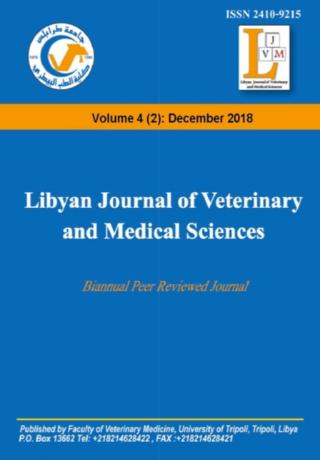
بعض المنشورات التي تم نشرها في كلية الطب البيطري

Isolation and Molecular Identification of Vibrio spp. by Sequencing of 16S rDNA from Seafood, Meat and Meat Products in Libya: A Descriptive Study

The main objective of this study was to characterize bacteria isolated from seafood, meat and meat products that may cause foodborne illnesses. We plan to use this data to help create a baseline for future research into foodborne illness in Libya. Several food-borne organisms in the genus Vibrio produce a variety of clinical disorders, including septicemia, cholera, and milder types of gastroenteritis. Vibrio cholerae, Vibrio parahemolyticus, and Vibrio vulnificus are among the Vibrio spp. that are usually related with food-borne transmission. A total of 93 samples (Table 1) of seafood, meat and meat products that includes 21 of shrimps; 5 of clam; 20 of fish; 34 samples of raw meat (10 beef, 9 camel meat, 6 mutton and 9 chickens) and 13 samples of meat products (2 beef sausages, 5 beef burgers, 5 chicken burgers and 1 kebab) were randomly collected from different geographic localities in Libya [Tripoli, Regdalin (120 km west of Tripoli), Janzour (30 km west of Tripoli) and Tobruk (1400 km east of Tripoli)]. Each sample was 250 g in weight. Out of the 93 cultured samples only 48 (51.6%) yielded colonies on Thiosulfate Citrate Bile Salt agar (TCBS) with culture characteristics of Vibrio spp. More than half (n=27) of processed seafood samples (n=46) yielded colonies on TCBS, while only 44.6% of samples of meat and meat products showed colonies on TCBS. Among cultured seafood samples, the highest bacterial count was recorded in clam with a count of 3.8 х10 4 CFU\g. Chicken burger samples showed the highest bacterial count with 6.5 х10 4 CFU\g. Molecular analysis of the isolates obtained in this study, showed that 11 samples out of 48 (22.9%) were Vibrio spp. Vibrio parahemolyticus was isolated from camel meat for the
Salah M. Azwai(1-2022)
Publisher's website

Necrotic Encephalitis associated with a Toxoplasma-like Protozoan Infection in Lambs

Introduction: A total of 32 young (1-3 months-old) lambs suffered from mortal neurological signs in a period of three months. The lambs were among the offspring of a herd of 300 sheep, in Tarhouna city, Libya. The affected lambs were initially treated with antibiotics, multivitamins and mineral supplements, however, none of these treatments attenuated the death toll among the small lambs. Methods: Three lamb carcasses were submitted to the National Center for Animal Health (NCAH) for post mortem examination. Gross pathological examination of the brains detected hydatid cysts and yellowish lesions within the cerebral cortex. Results: The histopathologic examination of the brain showed the presence of inflammatory lesions and necrotic features surrounded by granulomatous inflammatory patterns, which are accompanied by a few parasitic cysts. Ordinary and modified Ziehl-Neelsen stains for bacterial infection were performed, but the results did not strongly indicate bacterial infection. Toxoplasmosis, particularly T. gondii, and Neospora were first suspected. Immunohistochemistry testing for T. gondii did not show any conclusive indication for the presence of this pathogen. However, meticulous microscopic examination (100x) of the histopathologic features and the patterns of host-pathogen interaction of toxoplasmosis indicate that these lambs may have suffered from necrotic encephalitis associated with a different type of toxoplasmosis.
Abdulwahab Kammon(10-2021)
Publisher's website

Extent of pathogenic and spoilage microorganisms in whole muscle meat, meat products and seafood sold in Libyan market

Background: Whole muscle meat, meat products, and seafood contain different nutrients in adequate quantity providing a better environment for presence and replication of different microorganisms. There are underreported and inaccurate estimations of foodborne diseases due to the lack of effective surveillance systems in Libya. Aim: To determine the extent of microbiological contamination of whole muscle meat, meat products, and seafood. Methods: A total number of 731 samples of retail meat were collected from different stores in four cities in Libya. Samples were analyzed for aerobic plate count and subjected to microbiological enumeration and isolation techniques, followed by molecular identification by PCR and partial sequencing of 16S rDNA. Results: The results showed contamination of samples with enteric and spoilage bacteria. Fifteen genera of spoilage bacteria yielded 149 isolates which were detected and identified by PCR and partial sequencing of 16S rDNA as: Proteus spp., Provedencia spp., Raouttella ornithinolytical, Citrobacter spp., Enterobacter spp., Morganella morgi, Shewanella algea, Rhodobacter capsulatus, Listonella pelagia, Kluyvera spp., Pectobacterium spp., Brenneria spp., Klebsiella spp., Acintobacter radioresistens, and Pantoea spp. While for pathogenic bacteria, 143 isolates distributed among nine genera were identified by PCR and partial sequencing of 16S rDNA as: Bacillus spp., Escherichia spp., Shigella spp., Enterococci spp., Cronobacter spp., Staphylococci spp., Salmonella spp., Aeromonas spp., and Vibrio spp.. Many isolated bacteria are zoonotic bacteria with high importance for public health. Conclusion: Excessive handling and processing of meat and meat products seems to be one of the poorest microbiological qualities. These findings ought to be helpful in risk assessments and quality assurance of meat in order to improve food safety.
Ibrahim Eldagahyes(9-2020)
Publisher's website

قناة كلية الطب البيطري

بعض الفيديوات التي تعرض مناشط كلية الطب البيطري

اطلع علي المزيد