كلية الطب البيطري

المزيد ...

حول كلية الطب البيطري

تأسست كلية الطب البيطري عام 1975م كأول كلية للطب البيطري في ليبيا. تعد الكلية من قلاع العلم و المعرفة الهامة بجامعة طرابلس ومؤسسة علمية تلبي إحتياجات المجتمع من الأطباء البيطريين وتساهم في دعم الإقتصاد الوطني من خلال العناية بصحة الحيوان وزيادة الإنتاج الحيواني والمحافظة على صحة الإنسان وحماية البيئة.

حقائق حول كلية الطب البيطري

نفتخر بما نقدمه للمجتمع والعالم

194

المنشورات العلمية

86

هيئة التدريس

245

الطلبة

23

الخريجون

البرامج الدراسية

ماجستير أمراض الدواجن
تخصص أمراض الدواجن

يُنفذ هذا البرنامج من خلال دراسة مقررات دراسية، بحيث لا يقل عدد وحداتها عن (24) وحدة دراسية، وأن لا تزيد عن (30) وحدة دراسية على مدى 3 فصول، بالإضافة إلى إنجاز رسالة بحثية...

التفاصيل

ماجستير أمراض الاسماك
تخصص أمراض الاسماك

يُنفذ هذا البرنامج من خلال دراسة مقررات دراسية، بحيث لا يقل عدد وحداتها عن (24) وحدة دراسية، وأن لا تزيد عن (30) وحدة دراسية على مدى 3 فصول، بالإضافة إلى إنجاز رسالة بحثية...

التفاصيل

من يعمل بـكلية الطب البيطري

يوجد بـكلية الطب البيطري أكثر من 86 عضو هيئة تدريس

staff photo

د. عبدالقادر الضاوي الفيتوري الضاوي

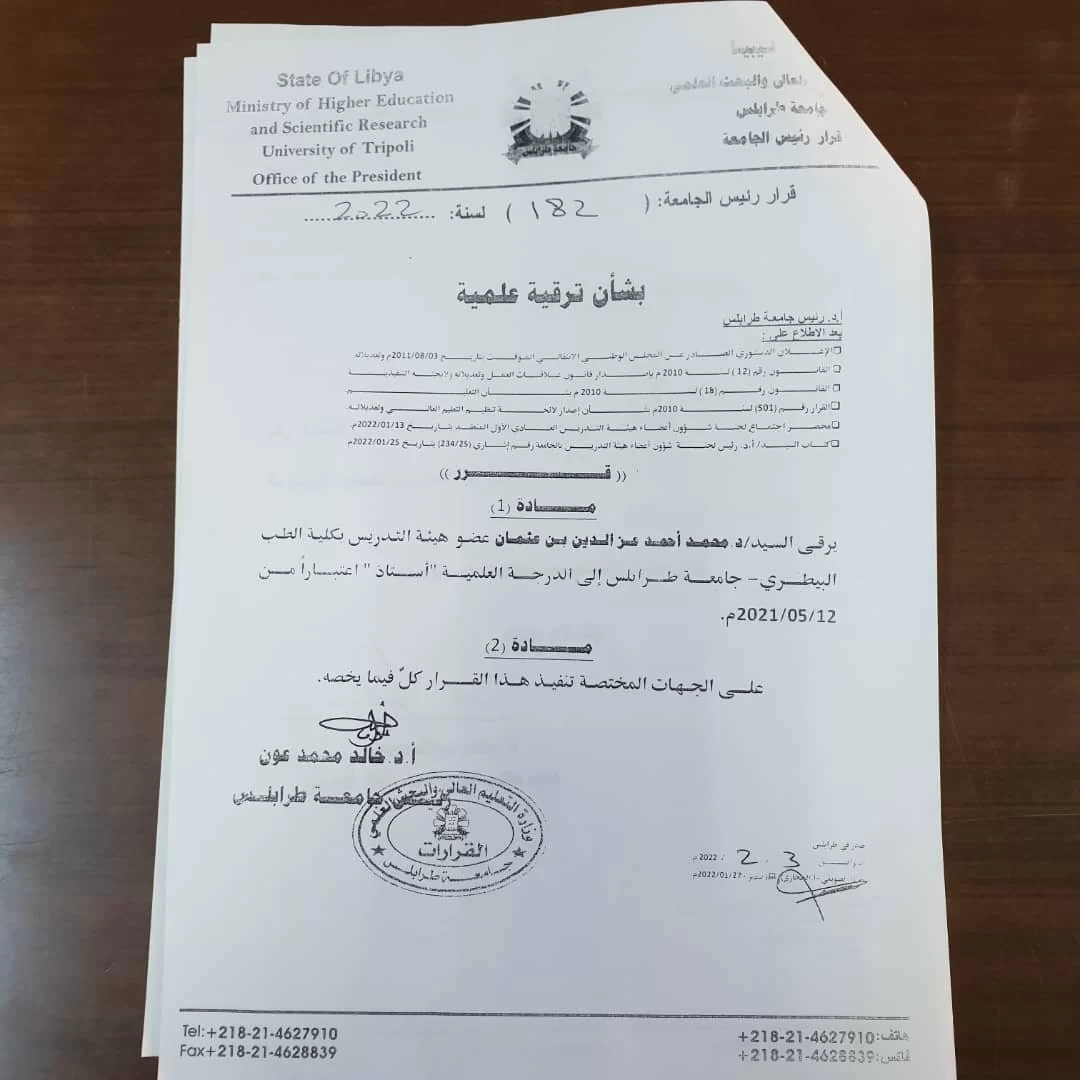
عبدالقادر هو احد اعضاء هيئة التدريس بقسم الاحياء الدقيقة والطفليات بكلية الطب البيطري. يعمل السيد عبدالقادر بجامعة طرابلس كـاستاذ مشارك منذ 01-04-2021 وله العديد من المنشورات العلمية في مجال تخصصه

منشورات مختارة

بعض المنشورات التي تم نشرها في كلية الطب البيطري

Salmonella Enteritidis’ Proteins produce in Vitro and in Vivo Protection against Colonization

Salmonella enterica can be considered as one of the most important causes of foodpoisoning with poultry thought to be the main source. Although S. Typhimurium, S. Enteritidis and the vast majority of other Salmonella serovars generally produce little systemic disease in adult chickens, they are able to colonize the alimentary tract of poultry. The two caeca are the main sites of the colonization of Salmonellae in chickens, and the bacteria can be easily harvested from the caeca for analysis. Bacterial proteins analysed utilizing SDS-PAGE showed differences between in vitro and in vivo that out of about 40 protein bands of in vitro preparation only a few (3-5) bands can be visualized from in vivo preparations. We suggested that some avian proteases might be responsible. Accordingly, and to investigate the hypothesis that bacterial-precipitated protein harvested from chickens is thought to be more protective than bacteria grown in broth culture, the immunogenicity of protein-precipitated vaccines harvested from chicken intestine and those from broth culture (in vitro), were compared using bacterial proteins as an orally inoculated vaccine candidate in chicken. The results demonstrated that the in vitro sonicated proteins obtained from a nutrient broth culture had a much better protective vaccine effect than the in vivo sonicated proteins preparations harvested from bacteria grown in chickens arabic 14 English 81
Altayeb Elazomi, Elhadi Araibi, Abdulgader Dhawi, Hatem Khpiza, Susan Liddell, Margret Lovell, Paul Barrow(12-2016)
Publisher's website

Clinical, radiological, and pathological findings of primary nasal osteosarcoma in a Libyan cat

Abstract Background: Although bone tumors are common pathologies in companion animals, limited reports describe nasal osteosarcoma (OSA) in cats. Case description: A case of nasal OSA in a local Libyan cat was admitted to the Veterinary Teaching Hospital at the Faculty of Veterinary Medicine, University of Tripoli–Libya, with nasal swelling and discharges and facial deformity. The radiological findings revealed nasal osteolysis with the absence of evidence of lung metastasis. In addition, fungal growth was not identified in microbiological culture. Furthermore, the pathological examination has grossly revealed a destructed nasal bone due to the presence of a tumor mass, with a mucohemorrhagic nasal discharge and absence of metastasis. OSA was confirmed histopathologically. Conclusion: This report presents the clinical, radiological, and pathological findings of a primary nasal OSA in a Libyan cat with no tumor metastasis to other body organs. Keywords: Cat, Nasal cavity, Primary osteosarcoma.
Mohamed Hamrouni S. Abushhiwa, Seham AL-Abed Hassan AL-Azreg, ٍٍSamer Khalifa Khalil Tmumen, Abdulrhman Mohamed Salah Alrtib, Abdulkareem Khalifa Ali Elbaz, Mahir A. Kubba, Al-Asayed R. Al-Attar, Emad M R Bennour(1-2019)
Publisher's website

Fetlock Parameters Development on Dorsopalmar Radiographs in the Equine Forelimb

Several reports have discussed possible bony morphological causes of fetlock pathology but without relating them to its morphometry. Radiographic measurement is widely used in constructing numerical databases of bone morphometry. Such measurements would not be reliable unless all factors affecting the radiographs were considered. Therefore, this study aimed to establish a specific dorsopalmar view (DP) for fetlock radiographic measurements, and then to develop reliable and repeatable fetlock parameters that represent fetlock conformation on those DP radiographs. Ten cadaveric forelimbs from ten adult horses were cut at the distal third of the radius and mounted in a normal posture for DP radiography. Specific features on fetlock bones were used as landmarks to identify the DP at zero degrees. Other bony features were selected as landmarks for developing fetlock parameters on these radiographs. Twenty-seven parameters were designed in the form of angles (12) and ratios (15). The repeatability and consistency of each parameter was tested. A specific fetlock DP view was determined at zero degrees based on certain landmarks. All angular and ratio parameters showed high reliability and consistency in their measurements. The established parameters provide an opportunity to test the relationship between fetlock morphometrics and performance, or the likelihood of certain pathologies.
Abdulrhman Mohamed Salah Alrtib, Aiman Hussein Saleh Oheida, Mohamed Hamrouni S. Abushhiwa, Helen M S Davies(3-2019)
Publisher's website

قناة كلية الطب البيطري

بعض الفيديوات التي تعرض مناشط كلية الطب البيطري

اطلع علي المزيد