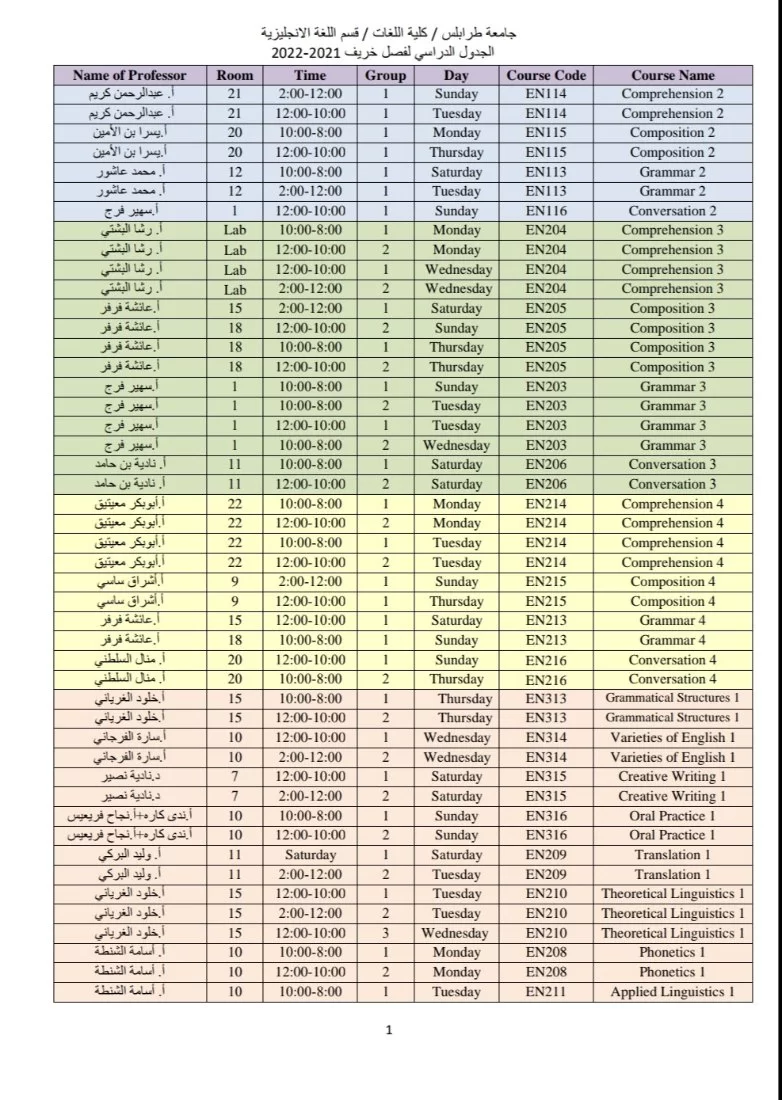
قسم اللغة الانجليزية

المزيد ...

حول قسم اللغة الانجليزية

تأسس قسم اللغة الانجليزية بمدينة طرابلس سنة  1965 و كان يتبع كلية المعلمين العليا  واستمر مع تغيير الاسم إلى كلية التربية سنة 1971م، ثم إلى مركز العلوم الإنسانية سنة 1986م.  في العام الدراسي 1986 -1987 تأسست كلية اللغات  تحت  اسم مركز اللغات , فى سنة 1988 صدر قرار اللجنة الشعبية العامة (سابقا) رقم 245 لسنة 1988 بتسمية المركز باسم كلية اللغات، في العام 2002   أدمجت كلية اللغات وكلية العلوم الاجتماعية والتطبيقية وكلية التربية تحت مسمى "كلية الآداب".

  في بداية فصل الخريف من العام الجامعي 2008-2009  أعيد نشاط كلية اللغات الأكاديمي في جميع مراحله عملا بقرار اللجنة الشعبية العامة (سابقا) رقم 535 لعام 2007   بشأن إعادة تنظيم الجامعات والمعاهد العليا ، ومن ثم تم فصل أقسام اللغات و من ضمنها قسم اللغة الانجليزية جميعها "طلابا وأساتذة" والتي كانت مند دمجة في كلية الآداب.

حقائق حول قسم اللغة الانجليزية

نفتخر بما نقدمه للمجتمع والعالم

11

المنشورات العلمية

48

هيئة التدريس

2154

الطلبة

0

الخريجون

من يعمل بـقسم اللغة الانجليزية

يوجد بـقسم اللغة الانجليزية أكثر من 48 عضو هيئة تدريس

staff photo

أ. أميمة أحمد عثمان المهدوي

أميمة أحمد المهدوي هي احدى أعضاء هيئة التدريس بقسم اللغة الانجليزية بكلية اللغات. تعمل السيدة أميمة أحمد المهدوي بجامعة طرابلس كـمحاضر مساعد منذ 2012 ولها العديد من المشاركات في مؤتمرات علمية في عدة جامعات ليبية.

منشورات مختارة

بعض المنشورات التي تم نشرها في قسم اللغة الانجليزية

The City of the White Wall: A Creative Writing about the Old City of Tripoli

Abstract: The Old City of Tripoli (the Medina) is one of the oldest surviving historical cities in the world, established as an (Emporium) in the second millennium B.C. Not only is it the most important urban settlement on the Libyan coast, but also one of the oldest capitals in the world. It is the city of the White Wall, and the researcher is the storyteller of its narrative in the lights of an experience of twenty years within the society of the Medina. In addition to the importance of its strategic location, some other significant dimensions of its story, architecture, culture, traditions and tourism are basically included.
مريم أحمد سلامة (2015)
Publisher's website

The Lady in Black

Abstract: The Lady in black is a narrative fiction novel of imaginative events and imaginative characters that are given a scope and a breathing space in real places to express their feelings and to make decisions of their own. Rami and his daughter, Rosalinda or the referred to as the Lady in black, are the main characters of this novel. Rami, the only son of the Libyan Sunni’s family made a journey to Palermo / Italy that resulted in getting his MD with honors, getting married to the Italian Lucia Ricci, the birth of his daughter, Rosalinda and his assassination in Rome. After having discovered that her father was not the Italian Bruno as she had thought for so long but the Libyan Rami, she broke up with the Bruno’s family and promised to revenge her biological father’s death. She accompanied the Palermo group in their sail to Libya not with the intention as they did to participate in the 2011 February liberation war, but mainly to find the assassins of her father and to revenge his death. She, however, found herself in the middle of the Libyans war and could not get anywhere and had to fight for her life, but she was arrested by the Gaddafi’s militia and was transferred to Rexes hotel in Tripoli. There she met the assassin face to face and shut him dead, declaring in her Libyan grandparents’ residence that her war was done and had to mix with action once more.
منار مبروك الأسطى (2014)
Publisher's website

The Most Effective Techniques for Testing the Lexical Competence of Third Year Secondary School Students- English Specialization at Gasser Al-khyar Area

Abstract Lexical competence can be defined as one's ability to use words differently and fully. This study is an attempt to investigate the effective techniques for testing the lexical competence in foreign language teaching. The study consists of four chapters. Chapter one is an introduction to the study. It focuses on the background of the study, and the problem of the study as well as the purpose and the hypotheses of the study. Chapter two deals with the definitions, characteristics, types and methods for testing lexical competence were given. This chapter also focuses on the testing language skills and what to test in testing learners' lexical competence. Chapter three is the practical part of the study. It includes subjects of the study and data for the study. The data consisted of the students' test and the teachers' questionnaire with their analysis and results. Chapter four is concerned with the concluding remarks that have been drawn from the study. Some recommendations on the appropriate use of testing vocabulary are also suggested in order to overcome the teachers and the student’s problems for techniques in testing and teaching lexical competence.
حميدة علي الباوندي (2015)
Publisher's website